Stop-arm photo enforcement is marketed with scary footage of cars passing stopped buses. NHTSA's own crash data tells a very different story about where the actual danger to kids comes from.
These figures come from NHTSA's own crash statistics, not from a camera vendor's sales deck. Read them side by side and the "passing motorist" panic doesn't hold up.
NHTSA tracks exactly who strikes school-age pedestrians in these crashes. The bus itself is the leading cause — by a wide margin — not the passing car a stop-arm camera is built to ticket.
None of this argues that passing a stopped school bus is safe — it's illegal and it should stop. The question is whether a camera bolted to a bus is the right tool, and whether the programs built around it are honest about their goals.
The larger source of school-transportation deaths — the bus itself, at 71% of pedestrian fatalities — gets far less attention than passing motorists, because there's no ticket revenue in citing a bus driver.
Raising awareness of stop-arm violations is a legitimate goal. Ticketing a car's registered owner weeks after the fact, with no warning at the moment of the violation, is a strange way to pursue it.
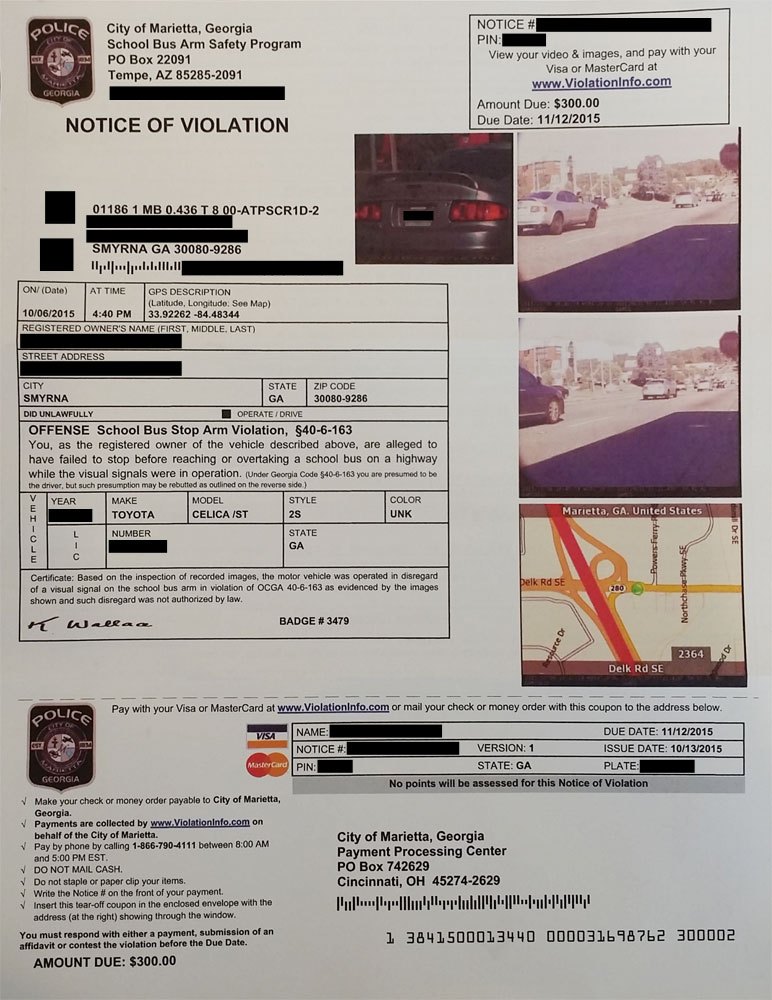
Drivers can be functionally entrapped: a stop arm can deploy with no reliable grace period, expecting a vehicle already in motion to stop as if by physics-defying magic. See the actual citations below.
Photo enforcement never notifies the driver in the moment. An officer who witnesses a violation can pull the driver over immediately; a camera program mails a notice weeks later.
These systems ticket the registered owner of the vehicle, not necessarily whoever was driving — a meaningful gap when the car is shared, borrowed, rented, or sold.
Out-of-state plates, business-registered vehicles, and in some jurisdictions government or diplomatic plates can sidestep these tickets with little consequence — while local drivers pay.
Obscured, missing, or unreadable plates are, by design, invisible to automated enforcement — systematically exempting exactly the drivers least likely to be otherwise accountable.
A ticket issued in error is disproportionately hard to fight: the burden falls on the driver to prove a negative, often against a private vendor with a financial stake in the outcome.

Motorists are expected to come to a complete stop the instant a stop arm deploys. We're not aware of any standard grace period built into these programs for a vehicle already in motion. Here are two documented cases.
The stop arm extended with the vehicle already committed to passing — there was no physical way to stop in time. An officer who witnessed this in person would very likely have used discretion. A camera does not.
The driver of a green Subaru reports passing roughly one to two seconds after the sign extended — far short of the screeching, physically impossible stop the citation assumes was possible.
NHTSA's traffic safety marketing office reports that illegal passing of a stopped school bus caused 63 fatalities nationwide from 2000 to 2024 — an average of 2.5 per year. Meanwhile, school buses themselves remain the leading cause of pedestrian deaths in school-transportation crashes.
Of the 97 school-age pedestrians killed in school-transportation-related crashes from 2008 to 2017, DOT found a majority were struck by school buses themselves, not by passing traffic.
DOT's report found roughly two-thirds of school-age pedestrians killed in school-transportation crashes over the prior decade were struck by school buses. In the single most recent year studied, zero were killed by a motorist passing a stopped bus.
A Texas driver received a collections demand for a citation tied to a bus route in a town that, according to the report, doesn't even operate school buses — a case study in why these programs deserve scrutiny.
Background on ViolationInfo.com and stop-arm camera tickets in Georgia, via SteaklyLawFirm.com (no affiliation with this site).
TheNewspaper.com covers an NTSB investigation into preventable school bus fatalities and the policy response.
We're always looking for documented cases, local news coverage, and official data that add to this record.